

Artificial Leadership in the Era of Limitless Intelligence
Artificial Leadership in the Era of Limitless Intelligence Leadership without clarity is artificial, no matter how sophisticated the tools behind
Five behavioral signals converged at the same moment in 2024. Together they describe a buyer who checks 5.2 sources, trusts peer validation over brand messaging, and decides in 4 days. Here’s what changed and what to do about it.
The chart above is not a prediction. Every line on it represents measured behavior: what buyers actually did when they researched and evaluated vendors between Q1 2023 and September 2025.
Five signals. Five independent behavioral measurements. And all five crossed at the same moment: Q3 2024.
That convergence wasn’t five separate trends. It was one shift expressing itself across five dimensions at once. Buyers changed how they discover, evaluate, and decide, all at the same time. And most organizations are still building for the world that existed in 2022.
In Q3 2024, something measurable happened. Buyers began checking more sources at the same time they started trusting brands less. They adopted AI platforms for research at the same time traditional search shifted to a verification role. Peer validation became effectively universal.
These didn’t happen sequentially. They happened together. That’s what makes this moment different from a typical market shift. It’s not a single new behavior to adapt to. It’s a fundamental change in the decision-making system.
Decision timelines compressed from 21 days to 4 days. Not because buyers became more decisive. Pattern-matching is faster than evaluation. They’re not reading your content more carefully. They’re scanning it more quickly. And what they’re scanning for is consistency across everything they find.
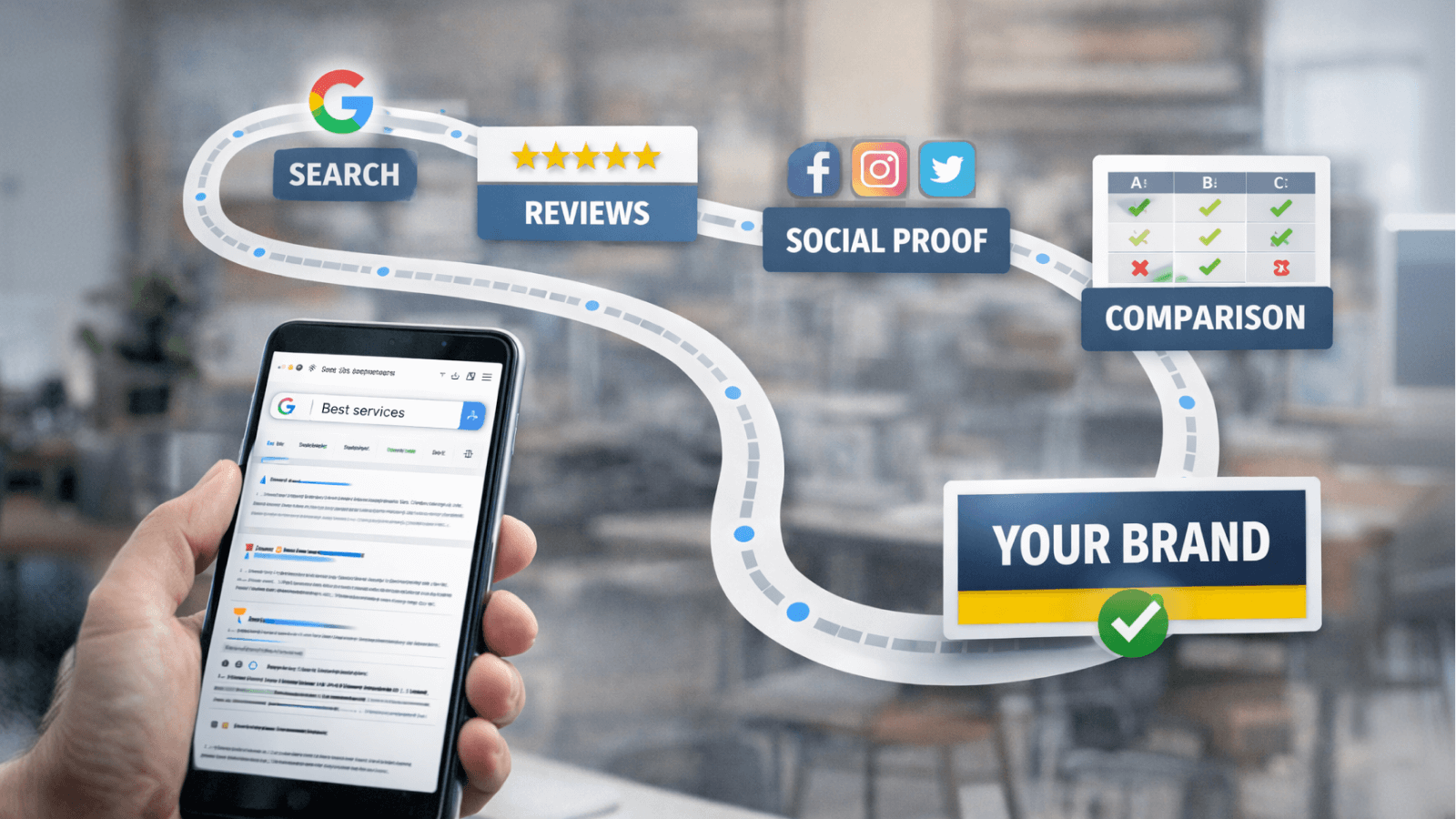
The operational implication is straightforward. You need presence across channels with consistent messaging, backed by peer validation. Missing any piece affects the whole. A buyer checking 5.2 sources will find you absent and move on. Absence from a channel reads as absence from consideration.
The average number of sources checked before a purchase decision went from 1.2 to 5.2. They’re not reading more. They’re scanning for consistency across more places.
When a buyer checked 1.2 sources, your website was the destination. Your messaging, your claims, your case studies: your messaging, your claims, your case studies were the primary evidence. You controlled the narrative because you were the primary channel.
At 5.2 sources, you’re one voice in a chorus you don’t control. The buyer finds you on AI, confirms on a review platform, validates on LinkedIn, cross-checks on a podcast mention, and then visits your website. By the time they arrive, they’ve already formed an impression. Your homepage is no longer an introduction. It’s a verification stop.
Presence in four or five discovery channels is now a minimum requirement for visibility, not a competitive advantage. If you’re absent from any channel where a buyer checks, you’re absent from their consideration set. Not partially considered. Coverage across channels is the new baseline.
Run the audit. Ask ChatGPT, Perplexity, and Google AI Overview: “What are the best [your category] companies?” Appearing here puts you in front of 60% of active buyers at the start of their research. That’s where consideration sets form.
LLM usage in vendor research went from effectively zero to 60% in less than three years. The inflection happened at Q3 2024, at the same moment everything else shifted.
In Q2 2025, AI platforms exceeded traditional search as a discovery channel. That’s not a milestone to note and move on from. That’s a structural inversion in how buyers find options.
When a buyer asks ChatGPT “who are the best CX consulting firms?” they receive a curated shortlist. If you’re on it, you’re in consideration. If you’re not, the conversation is over before it started. You don’t get a chance to compete for a spot you never appeared in.
What determines whether AI mentions your brand? Not paid placement. Not domain authority alone. It’s the depth, recency, and consistency of information about you that AI systems can find and verify. Peer reviews. Editorial coverage. Your own content structured in ways AI can extract. The brands winning AI visibility didn’t luck into it. They built for it.
AI visibility is directional. Create a standard list of 10 queries a buyer in your category would ask an AI. Run them monthly. Document whether you appear, how you’re described, and who else is named. That monthly snapshot tells you more than your quarterly web traffic report.
The percentage of buyers who trust direct vendor messaging without third-party validation dropped from 67% to 23%. Your website copy and marketing claims are now the starting point for a verification journey buyers complete elsewhere.
This is the most consequential number in the framework. When 67% of buyers were willing to take your claims at face value, investing in compelling brand messaging paid off. Your copywriters and content marketers were working with real leverage.
At 23%, the dynamic inverts. The more confident your claims, the more skepticism they generate. A buyer who reads “we deliver transformative customer experiences” on your homepage doesn’t feel persuaded. They go find out what other people say about you. Your marketing spend is now funding the first step in a verification journey, not the last step in a persuasion journey.
This isn’t brand messaging being less important. It’s brand messaging playing a different role. The job of your owned content is no longer to convince. It’s to provide the foundation that peer validation will confirm. Brands that understand this shift their investment accordingly. More investment in the proof systems that make claims believable.
Every claim on your website should have a corresponding external proof point: a review that confirms it, a case study that demonstrates it, an analyst mention that corroborates it. If you can’t point to external validation for a claim, treat it as unverified in the buyer’s eyes. Because that’s how they’re treating it.
92% of buyers now require third-party validation before trusting vendor claims. For any meaningful B2B decision, peer validation is universal. Assume every buyer will look for it.
The absolute percentage movement here is the smallest of the five signals. But the implication is the largest. Moving from 85% to 92% means peer validation went from nearly universal to effectively universal.
The buyer who doesn’t seek external proof is now the statistical exception. You cannot build a discovery strategy around converting the 8% who will take your word for it. You have to build for the 92% who won’t.
What counts as peer validation? Reviews with specific outcomes, not just star ratings. Case studies that name the client and quantify the result. Analyst mentions in third-party reports. Podcast appearances where someone else asks you to explain your thinking. Volume matters. Recency matters. Specificity matters most. A company with 200 reviews is more credible than a company with 15, regardless of average rating. The buyer reads volume as evidence that real people had real experiences with you.
Review generation is not a marketing task. It’s a trust infrastructure task. Set a minimum velocity: one new review per month as a baseline, one per week as a target. Track recency alongside volume. A company with 300 reviews and nothing in the last six months looks abandoned. A company with 40 reviews and one last week looks active and credible.
Traditional search is declining not because people use it less, but because its role in the decision process changed. Search went from discovery to verification. Buyers now find options elsewhere, then use Google to confirm what they found.
This is the shift that makes the others matter more. When search was discovery, ranking on page one of Google meant being found. When search became verification, ranking on page one means being confirmed, for buyers who already encountered you somewhere else.
When a buyer hears about you from an AI platform and finds consistent messaging in search, it confirms the impression. When they find you on a review platform and your website reinforces what the reviews say, trust compounds. Consistency at the verification stage multiplies everything built in the discovery stage.
SEO still matters. But the goal has changed. Search optimization is no longer about being found first. It’s about confirming what was already found. That requires consistent messaging across channels, structured content AI can extract, and a website that reinforces rather than contradicts everything a buyer has already learned about you.
Search for your own company name and your category on Google. What appears on page one should tell a consistent story with what a buyer finds on every other channel. If your website messaging, your review platform summary, and your AI answer all describe a different version of you. That’s the opportunity to close the gap.
Buyers check multiple sources in parallel, often in the same research session. These are the five channels where they look, and what they’re looking for in each one.
These are not targets to optimize toward. They are the current measurements that define what buyers expect. Falling below any threshold does not mean you perform worse. It means you may not be found at all.
Try AgenticCX free. Find out where you appear, how you’re described, and what buyers find when they check the five sources before they find you.
Try AgenticCX FreeArtificial Leadership in the Era of Limitless Intelligence Leadership without clarity is artificial, no matter how sophisticated the tools behind

The Group Hallucination Problem in Modern Marketing. Human minds do not pass intelligence to each other consistently. So marketing teams

Trust Is Not a Brand Metric. It Is Infrastructure. Three years. Three domains. One pattern. A government falls in ninety

Thoughtful positioning and steady visibility for growing brands.